Embarking on the journey of mastering how to manage time for study and work can feel like navigating a complex maze, filled with competing demands and the constant pressure to excel. This exploration delves into the heart of this challenge, uncovering the common pitfalls and psychological hurdles that often impede progress.
We will dissect the fundamental difficulties individuals face when attempting to balance academic pursuits with professional responsibilities. From identifying pervasive time management pitfalls to understanding the psychological factors that contribute to overwhelm, this guide aims to equip you with the insights needed to regain control of your schedule and boost your productivity.
Understanding the Core Challenge
Successfully managing both academic pursuits and professional responsibilities presents a significant hurdle for many individuals. This balancing act requires a strategic approach to time, energy, and focus, as the demands of each domain often compete for limited resources. The inherent difficulty lies in integrating disparate schedules, cognitive loads, and personal commitments into a cohesive and productive whole.The fundamental challenge stems from the finite nature of time and the often-overlapping, high-stakes demands of both study and work.
Students are typically expected to absorb new information, complete assignments, and prepare for assessments, all while professionals are accountable for project deadlines, client interactions, and team collaboration. Without effective management, this can lead to a feeling of being perpetually overwhelmed, impacting performance in both areas and potentially jeopardizing personal well-being.
Common Time Management Pitfalls
Individuals attempting to juggle study and work frequently encounter a range of common obstacles that hinder their progress and efficiency. Recognizing these pitfalls is the first step towards developing effective countermeasures and establishing a sustainable routine. These issues often arise from a lack of planning, unrealistic expectations, or an inability to prioritize effectively.
- Lack of Prioritization: Failing to distinguish between urgent and important tasks, leading to a reactive approach rather than a proactive one. This can result in spending too much time on low-impact activities while critical deadlines loom.
- Overcommitment: Accepting more responsibilities than can realistically be managed, whether in academic projects or work assignments, leading to burnout and compromised quality.
- Procrastination: Delaying tasks until the last minute, often due to feeling overwhelmed, perfectionism, or a lack of intrinsic motivation, which inevitably increases stress and reduces the quality of work.
- Inefficient Scheduling: Not allocating specific blocks of time for study and work, leading to constant context-switching and reduced focus. This can also include not accounting for travel time, breaks, or unexpected interruptions.
- Poor Energy Management: Neglecting personal well-being, such as sleep, nutrition, and exercise, which directly impacts cognitive function, concentration, and overall productivity.
- Distractions: Allowing social media, non-essential emails, or other interruptions to derail focus during dedicated study or work periods.
Psychological Factors Contributing to Poor Time Management
Beyond practical planning, several psychological factors significantly influence an individual’s ability to manage their time effectively when balancing study and work. These internal influences can create barriers to implementing time management strategies, even when the strategies themselves are sound. Understanding these psychological underpinnings is crucial for addressing the root causes of time management struggles.
- Perfectionism: The drive to achieve flawless results can lead to excessive time spent on tasks, delaying completion and creating a bottleneck. This often stems from a fear of criticism or failure.
- Fear of Missing Out (FOMO): The anxiety that an exciting or important event may currently be happening elsewhere, often exacerbated by social media, can lead to a constant feeling of distraction and an inability to commit fully to current tasks.
- Low Self-Efficacy: A lack of confidence in one’s ability to complete tasks or manage their workload can lead to avoidance and procrastination, creating a self-fulfilling prophecy of poor time management.
- Difficulty with Delayed Gratification: The tendency to prioritize immediate pleasure or relief over long-term goals. This can manifest as choosing to relax or engage in leisure activities instead of tackling demanding study or work tasks.
- Decision Fatigue: The mental exhaustion that results from making too many decisions. When faced with a complex schedule and numerous choices about how to allocate time, individuals can become paralyzed by indecision, leading to inaction.
- External Locus of Control: Believing that external forces, rather than personal effort, determine outcomes. This mindset can reduce motivation to plan and manage time effectively, as one feels less agency over their schedule and results.
Prioritization Strategies

Effectively managing your time between study and work hinges on a robust system of prioritization. Without a clear understanding of what needs your attention most, it’s easy to feel overwhelmed and fall behind on both fronts. This section delves into proven methods to help you distinguish between urgent and important tasks, ensuring your efforts are directed where they will yield the greatest impact.Developing a strategic approach to task management is not just about listing what needs to be done, but about understanding the relative importance and urgency of each item.
This allows for a more proactive and less reactive approach to your commitments, fostering a sense of control and efficiency.
Task Categorization Methods
Several established methods can assist in categorizing and ranking your responsibilities. These approaches help bring clarity to a busy schedule by providing frameworks for decision-making.
- Time Blocking: This involves allocating specific blocks of time in your calendar for particular tasks or types of activities, including study sessions and work duties. It encourages a disciplined approach to task completion.
- Batching Similar Tasks: Grouping similar activities together, such as responding to emails, making phone calls, or completing administrative work, can significantly improve efficiency by reducing context switching.
- Energy Level Alignment: Matching demanding tasks with periods of peak personal energy and less demanding tasks with lower energy periods can optimize productivity. For instance, tackling complex study problems when you’re most alert.
Creating a Hierarchical Task List
A hierarchical task list provides a clear visual representation of your priorities, breaking down larger goals into actionable steps. This structure is crucial for maintaining focus and ensuring that critical items are addressed first.To create an effective hierarchical list, begin by identifying all your academic and professional commitments. Then, for each major commitment, list the individual tasks required to achieve it.
Finally, rank these tasks based on their importance and deadlines.For example, consider a student working part-time:
- Major Commitment: Pass Midterm Exam
- Review lecture notes for Chapter 5 (High Importance, Urgent)
- Complete practice problems for Chapter 5 (High Importance, Urgent)
- Schedule study group meeting (Medium Importance, Urgent)
- Read assigned textbook chapter for next lecture (Medium Importance, Not Urgent)
- Major Commitment: Complete Work Project Report
- Gather data from sales figures (High Importance, Urgent)
- Analyze data and identify trends (High Importance, Urgent)
- Draft executive summary (High Importance, Urgent)
- Proofread and edit report (Medium Importance, Urgent)
- Major Commitment: Attend Weekly Class Lecture
- Prepare questions for the professor (Low Importance, Not Urgent)
- Take notes during lecture (High Importance, Urgent)
The Eisenhower Matrix for Study-Work Balance
The Eisenhower Matrix, also known as the Urgent-Important Matrix, is a powerful tool for categorizing tasks based on their urgency and importance. This framework helps individuals decide what to do, what to delegate, what to schedule, and what to eliminate.The matrix divides tasks into four quadrants:
- Quadrant 1: Urgent and Important (Do First): These are critical tasks that require immediate attention. Examples include looming deadlines for assignments or urgent work requests.
- Quadrant 2: Important, but Not Urgent (Schedule): These tasks are crucial for long-term goals but do not have an immediate deadline. This quadrant is key for proactive planning and development, such as long-term study planning or strategic work initiatives.
- Quadrant 3: Urgent, but Not Important (Delegate): These tasks demand immediate attention but do not significantly contribute to your goals. Often, these can be delegated to others if possible, or minimized. Examples might include certain interruptions or non-essential meetings.
- Quadrant 4: Not Urgent and Not Important (Eliminate): These are time-wasters that should be avoided or eliminated. This includes activities like excessive social media browsing or unimportant distractions.
Applying the Eisenhower Matrix to study-work balance involves consciously assigning each task to one of these quadrants. For instance, a pressing work deadline falls into Quadrant 1, while preparing for a final exam weeks away falls into Quadrant 2. The goal is to spend more time in Quadrant 2, which fosters growth and prevents tasks from becoming urgent crises.
“The key is not to prioritize what’s on your schedule, but to schedule your priorities.”
Stephen Covey
Daily Task Re-evaluation and Adjustment System
A dynamic system for re-evaluating and adjusting your daily task list is essential for maintaining flexibility and effectiveness. Circumstances change, and a rigid plan can quickly become obsolete.To design such a system, dedicate a short period at the end of each workday (or the beginning of the next) to review your progress and upcoming tasks. This review should involve:
- Assessing Completed Tasks: Mark off what you’ve accomplished and acknowledge your progress.
- Identifying New Tasks: Note any new responsibilities or unexpected demands that have arisen.
- Re-prioritizing: Based on the day’s progress and new information, re-order your task list. Consider shifting items between quadrants if using the Eisenhower Matrix.
- Adjusting Time Estimates: If tasks are taking longer than expected, revise your time allocations for subsequent days.
- Planning for Tomorrow: Artikel the top 3-5 most critical tasks for the following day.
For example, if a critical work project suddenly requires more attention than anticipated, you might need to reschedule a less urgent study session or delegate a minor task to free up time. Conversely, if a study assignment is completed ahead of schedule, you can reallocate that time to address a less urgent work item or focus on professional development. This continuous feedback loop ensures your plan remains relevant and achievable.
Effective Scheduling Techniques
Crafting a robust schedule is fundamental to effectively balancing the demands of both study and work. It transforms abstract goals into actionable steps, providing a clear roadmap for your week and day. This structured approach not only enhances productivity but also fosters a sense of control, reducing the likelihood of feeling overwhelmed. By intentionally allocating time for each commitment, you create a predictable rhythm that supports consistent progress.The key to effective scheduling lies in its adaptability and personalization.
A schedule is not a rigid cage, but rather a flexible framework designed to accommodate your unique needs and circumstances. It’s about making conscious choices about where your time goes, ensuring that both your academic pursuits and professional responsibilities receive the attention they deserve, without sacrificing essential personal well-being.
Time Blocking for Study and Work Management
Time blocking is a powerful scheduling technique that involves dividing your day or week into specific blocks of time, each dedicated to a particular task or category of tasks. This method is highly effective for managing both study and work because it promotes focused attention and minimizes context switching. When you allocate a specific time slot for studying, you are less likely to be distracted by work-related thoughts or emails, and vice versa.
This dedicated focus allows for deeper engagement with the material or task at hand, leading to improved comprehension and efficiency.The benefits of time blocking extend beyond mere productivity. It helps in:
- Reducing procrastination by creating clear start and end times for tasks.
- Improving time estimation skills as you become more aware of how long tasks actually take.
- Preventing burnout by ensuring that breaks and personal time are also scheduled.
- Enhancing mental clarity by reducing the mental load of constantly deciding what to do next.
- Providing a visual representation of your commitments, making it easier to identify potential conflicts or overcommitments.
Steps for Creating a Weekly Study and Work Schedule
Developing a weekly schedule that effectively integrates study and work requires a systematic approach. It’s about understanding your existing commitments and then strategically allocating time for your academic and professional goals. This process should be iterative, allowing for adjustments as you learn what works best for you.To create your weekly schedule, follow these steps:
- Assess Current Commitments: Begin by listing all fixed commitments, such as work hours, classes, appointments, and essential personal routines (e.g., commuting, meals, sleep).
- Identify Study Goals: Determine the specific study tasks you need to accomplish for the week. Break down larger assignments into smaller, manageable sub-tasks. Estimate the time required for each.
- Determine Work Priorities: Understand your key work responsibilities and deadlines for the week. Prioritize tasks based on urgency and importance.
- Allocate Study and Work Blocks: Based on your energy levels and existing commitments, assign specific time blocks for study and work. Consider scheduling more demanding tasks during your peak productivity hours.
- Schedule Personal Time and Breaks: Crucially, include time for rest, exercise, social activities, and hobbies. Short, regular breaks during study and work sessions are also essential for maintaining focus and preventing fatigue.
- Review and Adjust: At the end of each week, review your schedule. Identify what worked well and what didn’t. Make necessary adjustments for the following week to optimize your time management.
Digital Calendars versus Physical Planners
The choice between digital calendars and physical planners for scheduling is often a matter of personal preference and workflow. Both tools offer distinct advantages and disadvantages that can impact their effectiveness for managing study and work. Understanding these differences can help you select the best tool, or combination of tools, for your needs.Here’s a comparison of their pros and cons:
| Feature | Digital Calendars (e.g., Google Calendar, Outlook Calendar) | Physical Planners (e.g., Bullet Journals, Dated Planners) |
|---|---|---|
| Pros |
|
|
| Cons |
|
|
Sample Daily Schedule: Study, Work, and Personal Balance
A well-structured daily schedule is the cornerstone of effective time management. It ensures that all critical aspects of your life—study, work, and personal well-being—receive adequate attention. This sample schedule demonstrates how to integrate these components, emphasizing dedicated blocks for each and incorporating flexibility. Remember that this is a template; you should adapt it to your personal rhythm and specific demands.Here is a sample daily schedule: Morning (7:00 AM – 12:00 PM)
- 7:00 AM – 7:30 AM: Wake up, Hydrate, Light Stretching.
- 7:30 AM – 8:00 AM: Healthy Breakfast and Planning Review (briefly look at today’s schedule).
- 8:00 AM – 10:00 AM: Focused Study Block 1: Tackle your most demanding academic task while your mind is fresh.
- 10:00 AM – 10:15 AM: Short Break (walk around, grab a snack).
- 10:15 AM – 12:00 PM: Work Block 1: Begin your work tasks, focusing on high-priority items.
Afternoon (12:00 PM – 5:00 PM)
- 12:00 PM – 1:00 PM: Lunch Break and Personal Time (disconnect from work and study, engage in a relaxing activity).
- 1:00 PM – 3:00 PM: Work Block 2: Continue with work tasks, perhaps involving meetings or collaborative efforts.
- 3:00 PM – 3:15 PM: Short Break.
- 3:15 PM – 4:45 PM: Study Block 2: Review notes from earlier study sessions, work on less intensive assignments, or prepare for upcoming classes.
- 4:45 PM – 5:00 PM: Work/Study Wrap-up (organize notes, plan for tomorrow).
Evening (5:00 PM – 10:00 PM)
- 5:00 PM – 6:00 PM: Personal Time/Exercise: Engage in physical activity, pursue a hobby, or spend time with family.
- 6:00 PM – 7:00 PM: Dinner.
- 7:00 PM – 8:30 PM: Flexible Time: This could be for additional light study, catching up on personal errands, social activities, or simply relaxing.
- 8:30 PM – 9:30 PM: Wind-down Routine (reading, meditation, preparing for bed).
- 9:30 PM – 10:00 PM: Prepare for Sleep.
This schedule emphasizes dedicated blocks for deep work and study, interspersed with breaks and essential personal time, creating a sustainable rhythm for managing multiple responsibilities.
Productivity Enhancement Methods
To truly master time management for both study and work, it’s essential to equip yourself with strategies that boost your output and efficiency. This section delves into practical methods to enhance your productivity, ensuring that the time you allocate is used to its fullest potential. By implementing these techniques, you can create a more focused and effective environment for achieving your goals.Maximizing your productive hours often hinges on your ability to cultivate a work and study environment that minimizes disruptions and maximizes concentration.
Creating a sanctuary for focused work involves a conscious effort to identify and mitigate common sources of distraction.
Minimizing Distractions
Distractions are the silent thieves of productivity, diverting attention and fragmenting focus, which can significantly impact the quality and quantity of work completed. Actively managing your environment and digital presence is crucial for maintaining sustained concentration.Here are several techniques to help you minimize distractions:
- Digital Decluttering: Regularly close unnecessary browser tabs and applications. Utilize website blockers or focus apps that temporarily restrict access to distracting sites and social media during designated work or study periods.
- Notification Management: Turn off non-essential notifications on your phone and computer. Schedule specific times to check emails and messages rather than reacting to them as they arrive.
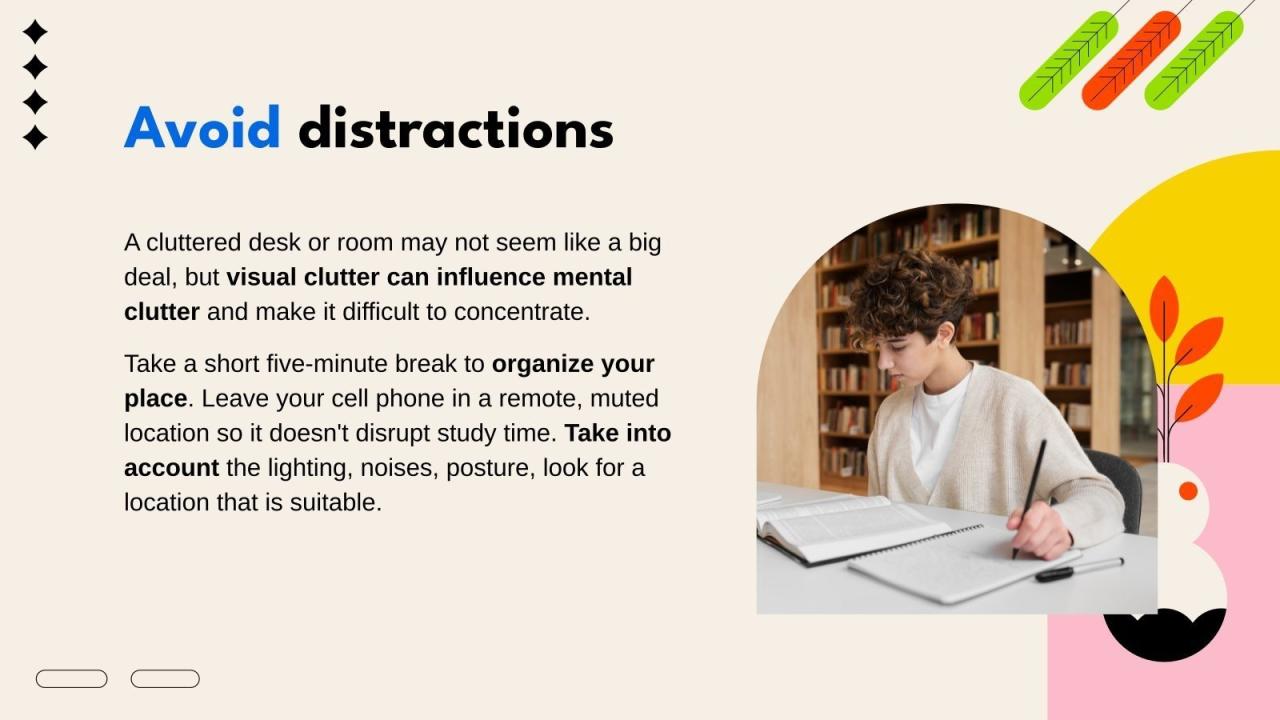
- Physical Environment Optimization: Designate a specific, quiet workspace. Keep your desk tidy and free from clutter. Inform housemates or family members about your work/study schedule to minimize interruptions.
- Background Noise Control: For some, complete silence is best, while others find ambient noise or instrumental music conducive to focus. Experiment to find what works for you, and consider noise-canceling headphones if your environment is inherently noisy.
- Task Batching: Group similar small tasks together (e.g., responding to emails, making phone calls) and complete them in one dedicated block of time to avoid context switching.
The Pomodoro Technique for Focused Work
The Pomodoro Technique is a time management method developed by Francesco Cirillo in the late 1980s. It uses a timer to break down work into intervals, traditionally 25 minutes in length, separated by short breaks. This structured approach is designed to improve focus and prevent burnout.To implement the Pomodoro Technique:
- Choose a Task: Select a specific task you want to work on.
- Set the Timer: Set a timer for 25 minutes (this is one “Pomodoro”).
- Work Intensely: Work on the task with full concentration until the timer rings. Avoid any distractions during this period.
- Short Break: When the timer rings, take a short break of 5 minutes. Stretch, walk around, or do something unrelated to your work.
- Repeat: After four Pomodoros, take a longer break of 15-30 minutes.
This cycle helps maintain a high level of focus by creating a sense of urgency and rewarding consistent effort with regular breaks.
Improving Concentration and Focus
Sustained concentration is a skill that can be developed and enhanced through consistent practice and the application of specific strategies. Building your capacity to focus allows for deeper engagement with your material and more efficient task completion.Actionable advice for improving concentration includes:
- Mindfulness and Meditation: Regular practice of mindfulness can train your brain to stay present and reduce mind-wandering. Even a few minutes of daily meditation can yield significant benefits.
- Adequate Sleep: Prioritize getting 7-9 hours of quality sleep per night. Sleep deprivation severely impairs cognitive functions, including attention and concentration.
- Regular Physical Activity: Exercise has been shown to improve cognitive function, including focus and memory. Incorporate physical activity into your routine, even short walks can be beneficial.
- Healthy Diet: Nourishing your body with a balanced diet supports brain health. Avoid excessive sugar and processed foods, which can lead to energy crashes and affect concentration.
- Single-Tasking: Resist the urge to multitask. Focus on completing one task before moving to the next. This reduces cognitive load and improves the quality of your work.
Effective Breaks for Enhanced Productivity
Taking breaks is not a sign of weakness or a waste of time; it is a crucial component of sustained productivity. Effective breaks allow your mind to rest and recharge, preventing mental fatigue and improving your ability to concentrate upon returning to your tasks.Suitable activities for effective breaks include:
- Physical Movement: Stand up, stretch, walk around, or do some light exercises. This helps to combat the effects of prolonged sitting and improves blood circulation to the brain.
- Engage in a Non-Work Related Activity: Listen to music, read a few pages of a book, or engage in a brief conversation. These activities provide a mental reset.
- Hydration and Nutrition: Drink water or have a healthy snack. This ensures your body is adequately fueled, supporting cognitive function.
- Brief Relaxation: Close your eyes and practice deep breathing exercises for a few minutes. This can help reduce stress and clear your mind.
- Step Away from Screens: If possible, spend your break away from your computer or phone screen to give your eyes and mind a rest from digital input.
Resource Management and Delegation
Effectively managing your time for both study and work hinges significantly on how well you utilize the resources at your disposal and how adeptly you delegate tasks. This involves a strategic approach to identifying, accessing, and leveraging available assets, whether they are human, technological, or informational. Understanding when and how to share responsibilities can unlock greater efficiency and reduce individual burden, leading to more balanced and productive outcomes.This section delves into the practical application of resource management and delegation, providing actionable insights to enhance your time management strategies.
By optimizing the use of your resources and mastering the art of delegation, you can significantly improve your capacity to handle multiple demands without succumbing to overwhelm.
Utilizing Available Resources
Leveraging existing resources is a cornerstone of efficient time management. This encompasses a wide array of assets, from human capital and technological tools to information and even your own energy reserves. A proactive approach to identifying and utilizing these resources can prevent bottlenecks and accelerate progress in both academic and professional pursuits.Resources can be broadly categorized, and their effective deployment requires a clear understanding of their potential and limitations:
- Information Resources: This includes access to libraries, online databases, research papers, academic journals, and industry reports. For study, it means accessing relevant literature for assignments and research. In work, it translates to utilizing market research, company data, and competitor analysis.
- Technological Resources: Modern technology offers a plethora of tools that can streamline tasks. This ranges from specialized software for project management and data analysis to communication platforms and cloud storage solutions. Utilizing these tools can automate repetitive tasks, improve collaboration, and provide quick access to information.
- Human Resources: In a work setting, this refers to colleagues, supervisors, and support staff. In academic settings, it includes professors, teaching assistants, study groups, and mentors. Engaging with these individuals for advice, support, or task collaboration can significantly lighten your load and provide diverse perspectives.
- Financial Resources: While not always directly related to time management, financial resources can indirectly impact it. For example, investing in time-saving tools or outsourcing certain tasks can free up valuable time.
- Personal Resources: This includes your own skills, knowledge, energy levels, and even your physical environment. Ensuring you are well-rested, have a conducive workspace, and are utilizing your strengths effectively are crucial for sustained productivity.
Delegating Tasks Effectively
Delegation is the strategic assignment of tasks to others, allowing you to focus on higher-priority activities. This is not about shirking responsibility but about optimizing workflow and empowering others. Successful delegation requires careful consideration of the task, the individual, and clear communication.Methods for effective delegation include:
- Task Assessment: Before delegating, evaluate the task. Is it something that can be effectively handled by someone else? Does it align with another person’s skills or development goals?
- Recipient Selection: Choose the right person for the job. Consider their current workload, skill set, experience, and willingness to take on the task. Delegating to someone who is overextended or lacks the necessary skills will likely lead to more problems than it solves.
- Clear Communication of Expectations: Provide detailed instructions, including the desired outcome, deadlines, and any specific parameters. Ensure the recipient understands the ‘why’ behind the task, which can foster greater commitment.
- Granting Authority: Empower the delegatee with the necessary authority to complete the task. This might include access to information, resources, or decision-making power.
- Providing Support and Resources: Ensure the delegatee has the tools, information, and support they need to succeed. Be available to answer questions and offer guidance without micromanaging.
- Establishing Checkpoints and Feedback Mechanisms: Schedule regular check-ins to monitor progress and provide feedback. This allows for course correction if needed and reinforces learning for the delegatee.
- Recognizing and Appreciating Efforts: Acknowledge and appreciate the efforts of those you delegate to. Positive reinforcement can encourage future willingness to assist.
In a study group setting, delegation might involve dividing research topics, assigning sections of a presentation, or sharing the responsibility for note-taking. In a work environment, it can range from assigning specific project components to administrative tasks.
Tools and Technologies for Task Management and Organization
A wide array of tools and technologies can significantly aid in managing tasks and maintaining organization for both study and work. These digital aids can centralize information, automate reminders, and facilitate collaboration, thereby reducing the cognitive load associated with juggling multiple responsibilities.Key categories of tools and technologies include:
- Project Management Software: Platforms like Asana, Trello, Monday.com, and Jira offer features for task creation, assignment, progress tracking, deadline management, and team collaboration. They provide a visual overview of ongoing projects and individual responsibilities.
- Note-Taking Applications: Tools such as Evernote, OneNote, Notion, and Google Keep allow for organized storage of notes, documents, web clippings, and ideas. Many offer features for tagging, searching, and creating to-do lists, making information retrieval efficient.
- Calendar and Scheduling Applications: Google Calendar, Outlook Calendar, and Calendly help in blocking out time for specific tasks, scheduling meetings, and setting reminders. Integrating these with other productivity tools can create a seamless workflow.
- Communication and Collaboration Platforms: Slack, Microsoft Teams, and Zoom facilitate real-time communication, file sharing, and virtual meetings, which are essential for group projects and remote work.
- Cloud Storage Services: Google Drive, Dropbox, and OneDrive provide secure storage and easy access to documents from any device, ensuring that important files are always available and can be shared effortlessly.
- Time Tracking Tools: Applications like Toggl Track and Clockify can help you understand how you spend your time, identify time sinks, and ensure you are allocating sufficient time to important tasks.
The effectiveness of these tools lies in their consistent use and integration into your daily routine. Choosing tools that align with your personal workflow and the specific demands of your study and work environments is crucial.
Individual Versus Collaborative Task Management Approaches
Both individual and collaborative task management approaches have their merits, and the optimal strategy often involves a blend of both. Understanding their respective strengths and weaknesses can help you decide when to lean on one over the other.
Individual Task Management
This approach emphasizes self-reliance, personal discipline, and the ability to manage one’s own workload independently.
- Strengths:
- Autonomy and Control: You have complete control over how and when tasks are performed.
- Flexibility: Easier to adapt schedules and priorities on the fly.
- Deep Focus: Allows for uninterrupted concentration on complex tasks.
- Personalized Workflow: You can tailor your methods to your unique learning or working style.
- Weaknesses:
- Potential for Isolation: Can lead to a lack of diverse perspectives or support.
- Risk of Overwhelm: Managing everything alone can be daunting and lead to burnout.
- Limited Skill Set: You may lack the specific expertise required for certain tasks.
- Slower Progress on Large Projects: Complex projects can take significantly longer to complete alone.
Collaborative Task Management
This approach involves working with others, sharing responsibilities, and leveraging collective skills and knowledge.
- Strengths:
- Shared Workload: Distributes tasks, reducing individual burden.
- Diverse Skill Sets: Access to a wider range of expertise and perspectives.
- Faster Project Completion: Complex tasks can be accomplished more efficiently.
- Enhanced Learning and Development: Opportunities to learn from peers and mentors.
- Increased Motivation and Accountability: Group dynamics can foster a sense of commitment.
- Weaknesses:
- Coordination Challenges: Requires effective communication and alignment of schedules.
- Potential for Conflict: Disagreements on approach or execution can arise.
- Uneven Contribution: Risk of some members contributing less than others.
- Dependency on Others: Progress can be hindered by the performance of team members.
The effectiveness of each approach is highly context-dependent. For tasks requiring deep, solitary focus, individual management is often best. For complex projects that benefit from multiple viewpoints or require specialized skills, collaboration is invaluable. The key is to recognize when each approach is most beneficial and to employ strategies that mitigate their respective weaknesses. For instance, using collaborative tools can bridge the coordination gap in group work, while setting clear individual goals within a collaborative framework ensures personal accountability.
Maintaining Well-being and Avoiding Burnout

Effective time management extends far beyond mere task completion; it is intrinsically linked to our overall personal well-being. By consciously allocating time for rest, recovery, and personal pursuits, we build resilience against the pressures of demanding study and work commitments. This proactive approach ensures that our productivity is sustainable and our mental and physical health remain robust.Integrating self-care into a packed schedule might seem challenging, but it is essential for long-term success and happiness.
It involves making deliberate choices to prioritize activities that recharge and rejuvenate us, preventing the depletion of our energy reserves.
The Critical Link Between Time Management and Personal Well-being
The ability to manage time effectively directly impacts our well-being by creating a sense of control and reducing feelings of overwhelm. When we can allocate sufficient time for all aspects of our lives – professional, academic, and personal – we foster a healthier work-life balance. This balance is crucial for preventing chronic stress, which can lead to a myriad of physical and psychological health issues.
A well-managed schedule allows for adequate sleep, regular exercise, and time for hobbies and social connections, all of which are fundamental pillars of good health.
Incorporating Self-Care Activities into a Busy Schedule
Making time for self-care is not a luxury but a necessity for sustained performance and mental clarity. It requires intentional planning and a commitment to oneself.Here are practical strategies for weaving self-care into your daily and weekly routines:
- Schedule Non-Negotiable Breaks: Treat short breaks throughout the day as important appointments. These could be 5-10 minute periods to stretch, meditate, or simply step away from your work.
- Prioritize Sleep Hygiene: Aim for 7-9 hours of quality sleep each night. Establish a consistent sleep schedule, create a relaxing bedtime routine, and ensure your sleep environment is conducive to rest.
- Dedicate Time for Physical Activity: Even short bursts of exercise, like a brisk walk during lunch or a quick home workout, can significantly boost energy levels and reduce stress.
- Engage in Hobbies and Interests: Set aside time each week for activities you genuinely enjoy, whether it’s reading, painting, playing music, or spending time in nature.
- Foster Social Connections: Make an effort to connect with friends and family regularly. Social support is a powerful buffer against stress.
- Practice Mindfulness or Meditation: Even a few minutes of daily mindfulness can help calm the mind and improve focus.
Signs of Burnout and Proactive Prevention Measures
Burnout is a state of emotional, physical, and mental exhaustion caused by prolonged or excessive stress. Recognizing its early signs is key to preventing it from escalating into a more serious condition.Common indicators of burnout include:
- Chronic fatigue and low energy levels
- Increased cynicism and detachment from work or studies
- Reduced sense of accomplishment and effectiveness
- Irritability, anxiety, or feelings of hopelessness
- Physical symptoms such as headaches, digestive issues, or weakened immunity
Proactive measures to prevent burnout involve a combination of mindful time management and a commitment to self-preservation.
- Set Clear Boundaries: Define when your work or study day begins and ends. Avoid checking emails or working late into the night unless absolutely necessary.
- Learn to Say No: Politely decline additional tasks or commitments when your plate is already full. Overcommitting is a direct path to burnout.
- Seek Support: Talk to supervisors, colleagues, friends, or family about your workload and stress levels. Sometimes, simply voicing your concerns can be helpful, and they may offer practical solutions or support.
- Regularly Assess Your Workload: Periodically review your commitments to ensure they are manageable and aligned with your goals.
- Take Your Vacation Time: Do not let vacation days go unused. Time off is essential for recovery and gaining fresh perspective.
Framework for Setting Realistic Expectations and Managing Stress Levels
Establishing realistic expectations and effectively managing stress are foundational to maintaining well-being while pursuing ambitious goals. This framework encourages a balanced perspective and proactive stress mitigation. Core Principles:
- Self-Awareness: Understand your personal limits, energy levels, and the impact of stress on your performance and health.
- Adaptability: Recognize that plans may need to change and be flexible in your approach.
- Proportionality: Ensure that the demands placed on your time are proportionate to the resources and energy available.
Practical Application:
To implement this, consider the following steps:
- Define Your “Enough”: For each project or task, identify what constitutes a successful outcome rather than an impossibly perfect one. This helps in setting achievable goals.
- Regular Check-ins: Schedule brief, weekly self-assessments to gauge your stress levels, energy, and overall well-being. Ask yourself: “How am I feeling?” and “What adjustments can I make?”
- Scenario Planning: For significant tasks or periods of high demand, anticipate potential challenges and develop contingency plans. This reduces anxiety when unexpected issues arise.
- Embrace Imperfection: Understand that not every task needs to be executed with 100% perfection. Aim for excellence, but recognize that “good enough” is often sufficient and prevents unnecessary stress.
- Recharge Rituals: Establish consistent rituals for unwinding and recharging, such as a specific evening routine or a weekend activity that you look forward to. These act as built-in stress relievers.
“The key is not to prioritize what’s on your schedule, but to schedule your priorities.”Stephen Covey. This quote underscores the importance of aligning our time with what truly matters for both our productivity and our well-being.
Adapting to Changing Circumstances

In the dynamic interplay between study and work, unforeseen events are not exceptions but rather an inherent part of the process. Successfully navigating these disruptions is crucial for maintaining progress and achieving long-term goals. This section focuses on developing the resilience and adaptability needed to adjust your time management strategies when the unexpected arises.The ability to adapt is a cornerstone of effective time management.
It allows you to pivot without losing significant ground, ensuring that both your academic and professional responsibilities remain on track, even when faced with challenges. This involves a proactive mindset and a toolkit of strategies to manage deviations from your planned schedule.
Adjusting Schedules for Unexpected Events
Life rarely adheres strictly to our meticulously crafted plans. When unexpected events, whether personal or professional, disrupt your study and work schedule, a flexible approach is essential. The key is to have a system in place that allows for quick and efficient recalibration of your commitments.When an unexpected event occurs, the first step is to acknowledge its impact and assess the immediate demands it places on your time.
This might involve a sudden family emergency, an urgent work project, or a health issue. Instead of letting it derail your entire schedule, aim to make targeted adjustments. This could mean temporarily shifting lower-priority tasks, reallocating time from less critical activities, or communicating potential delays to relevant parties. For instance, if a critical work deadline is moved up, you might need to postpone a study session or delegate a less time-sensitive work task.
Conversely, if a study-related commitment requires immediate attention, you might need to communicate with your team about a slight delay on a non-critical work item.
Maintaining Momentum Through Setbacks
Setbacks are inevitable in any demanding endeavor. Whether it’s a failed exam, a project delay at work, or simply a period of low motivation, it’s important to have strategies to regain momentum and continue moving forward. The goal is to prevent a single setback from becoming a reason to abandon your efforts altogether.To maintain momentum when facing setbacks, it’s helpful to first reframe your perspective.
View setbacks not as failures, but as learning opportunities. Analyze what went wrong, identify lessons learned, and incorporate these insights into your future planning. After a setback, take a short, focused break to recharge, then return to your tasks with renewed energy. Breaking down larger goals into smaller, more manageable steps can also make them feel less daunting and help you regain a sense of accomplishment with each completed mini-task.
For example, if a research paper was rejected for revision, instead of feeling discouraged, focus on the specific feedback and tackle the revisions one section at a time.
Reassessing Priorities with Fluctuating Workloads
The volume of work in both study and professional environments can fluctuate significantly. Periods of intense activity may be followed by lulls, and vice versa. Effective time management requires the ability to reassess and reorder your priorities dynamically as these changes occur.When your workload fluctuates, a regular review of your priorities is essential. This involves revisiting your task list and aligning it with your current goals and deadlines.
Tools like the Eisenhower Matrix (Urgent/Important) can be particularly useful here. During busy periods, focus on high-priority, urgent tasks, while during slower periods, you can allocate more time to less urgent but still important activities, such as professional development or long-term study planning. For instance, if a major project at work concludes, you might reassess your study plan and dedicate more time to a challenging course that you had previously put on the back burner.
The Importance of Flexibility in Time Management
Flexibility is not a sign of weakness in time management, but rather a testament to its robustness and effectiveness. A rigid schedule is prone to breaking when faced with the inevitable disruptions of life. Embracing flexibility allows you to create a sustainable and adaptable system that can weather challenges and still lead you towards your objectives.Flexibility enables you to respond effectively to unexpected demands without compromising your overall progress.
It involves building buffer time into your schedule for unforeseen events, being willing to adjust deadlines when necessary, and maintaining a positive attitude when plans need to change. This adaptability ensures that your time management system serves you, rather than you serving a rigid schedule. For example, if you have a flexible work arrangement, you can adjust your work hours to accommodate a last-minute study group meeting, and then make up the work time later in the week.
Tools and Technologies for Time Management
In today’s digital age, a plethora of tools and technologies are available to significantly enhance our ability to manage study and work time effectively. These digital assistants can streamline workflows, improve organization, and provide valuable insights into how our time is being spent, ultimately leading to greater productivity and reduced stress.The landscape of time management tools is diverse, offering solutions for various needs, from simple task tracking to complex project oversight.
By leveraging these technologies, individuals can transform their approach to balancing academic and professional responsibilities.
Digital Tools for Time Management
Digital tools designed for time management offer a range of functionalities to support individuals in their pursuit of effective scheduling and task completion. These applications often integrate multiple features, such as task lists, calendar views, progress tracking, and collaboration capabilities, providing a centralized hub for managing commitments.Key functionalities commonly found in these tools include:
- Task Management: Allowing users to create, organize, and prioritize tasks with due dates, subtasks, and recurring options.
- Project Planning: Enabling the breakdown of larger projects into smaller, manageable steps, often with visual aids like Gantt charts.
- Time Tracking: Monitoring the actual time spent on different tasks or projects, providing data for analysis and optimization.
- Collaboration: Facilitating teamwork by allowing shared task lists, project boards, and communication within the application.
- Reminders and Notifications: Alerting users to upcoming deadlines, scheduled events, or incomplete tasks.
Project Management Applications for Individuals
For individuals who find themselves juggling numerous study projects, work assignments, and personal commitments, project management applications offer robust solutions. These platforms are designed to handle complexity, allowing for detailed planning, execution, and monitoring of multiple endeavors simultaneously.Here is a comparison of popular project management applications suitable for individuals managing multiple commitments:
| Application | Core Functionalities | Best For | Key Features for Individuals |
|---|---|---|---|
| Trello | Kanban-style boards, task cards, checklists, due dates, attachments. | Visual task management, simple project organization. | Intuitive drag-and-drop interface, easy to visualize progress across different projects or study areas. |
| Asana | Task lists, project boards, timelines, calendars, portfolios, team communication. | Comprehensive project management, workflow automation. | Ability to create detailed project plans, assign tasks to oneself with specific deadlines, and track progress across multiple academic and work streams. |
| Todoist | Task lists, subtasks, recurring tasks, labels, filters, integrations. | Personal task management, simple to-do lists. | Powerful natural language input for quick task creation, cross-platform synchronization, and flexible organization options for both study and work tasks. |
| Notion | All-in-one workspace, notes, databases, task management, wikis, project management. | Highly customizable, integrated workspace for notes, tasks, and projects. | Can create a single, interconnected system for notes, lecture summaries, research papers, work reports, and project plans, all linked together. |
Calendar Applications for Scheduling and Reminders
Calendar applications are foundational tools for effective time management, providing a visual representation of commitments and a reliable system for reminders. They are indispensable for ensuring that study sessions, work meetings, deadlines, and personal appointments are not missed.The features of calendar applications that facilitate scheduling and reminders for both study and work include:
- Event Creation: Easily add appointments, lectures, meetings, and study blocks with specific start and end times.
- Recurring Events: Set up regular study groups, weekly team meetings, or daily review sessions to appear automatically.
- Color-Coding: Differentiate between study-related events, work tasks, and personal activities through customizable color schemes, offering a quick visual overview.
- Notifications and Alerts: Configure reminders for upcoming events at specified intervals (e.g., 15 minutes before, 1 hour before) to ensure timely preparation and attendance.
- Integration with Other Tools: Many calendars can sync with email clients and task management apps, consolidating all time-sensitive information in one place.
- Sharing Capabilities: Share your availability or specific events with colleagues, study partners, or family members.
For instance, a student might schedule a block for “Research Paper Writing” from 2 PM to 5 PM on Tuesdays and Thursdays, with a reminder set for 1:45 PM. Simultaneously, they could block out “Team Meeting” from 10 AM to 11 AM every Monday, with a notification 10 minutes prior.
Note-Taking Applications for Capturing Ideas and Organizing Tasks
Note-taking applications serve as a crucial repository for ideas, insights, and tasks that arise during study and work. They allow for the immediate capture of information, preventing valuable thoughts from being forgotten and providing a structured way to organize them for future action.The role of note-taking applications in capturing ideas and organizing tasks related to academic and professional pursuits is multifaceted:
- Idea Capture: Quickly jot down lecture notes, brainstorm project ideas, record meeting minutes, or save interesting articles and web links.
- Task Generation: Convert captured ideas or information directly into actionable tasks within the note-taking app or by linking them to a dedicated task manager.
- Organization and Tagging: Use notebooks, folders, and tags to categorize notes by subject, project, or priority, making it easy to retrieve relevant information.
- Rich Media Support: Many applications allow for the inclusion of images, audio recordings, sketches, and even web clippings, enriching the context of notes.
- Search Functionality: Powerful search capabilities enable users to quickly find specific information within a vast collection of notes.
- Cross-Platform Sync: Access notes from any device, ensuring that information is available whether you are in a lecture hall, at your desk, or on the go.
For example, a student might use a note-taking app to capture key concepts from a textbook chapter, then create a task to review those concepts before the next class. Similarly, a professional could jot down ideas during a client call and then create follow-up tasks directly from those notes.
Last Point

In essence, effectively managing your time for study and work is not merely about scheduling tasks; it’s about cultivating a sustainable rhythm that honors your commitments while safeguarding your well-being. By embracing strategic prioritization, innovative scheduling, and mindful productivity techniques, you can transform the chaos of competing demands into a harmonious flow. Remember, flexibility and self-care are your allies in this ongoing endeavor, ensuring that your journey is both productive and personally fulfilling.